
Weighted A*
Turn a speed dial: trade a little optimality for a lot of speed.
The idea
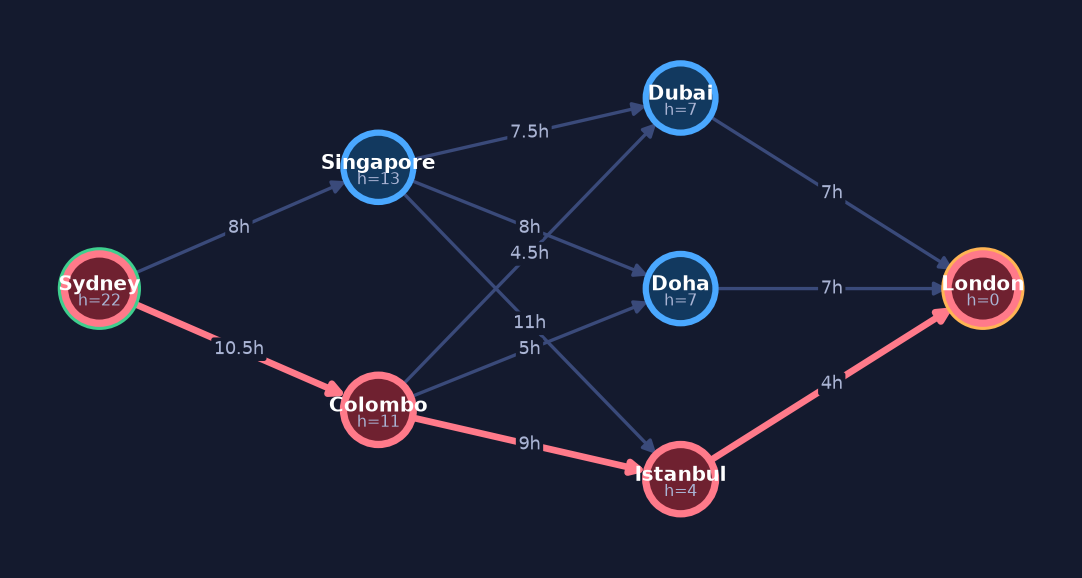
Weighted A* is A* with a "greediness dial." It uses f(n) = g(n) + w*h(n), where w is a weight bigger than 1 that exaggerates the estimate of remaining distance to the goal. This makes the search rush toward the goal faster, expanding fewer nodes, at the cost of possibly finding a path that isn't the shortest. The bigger w is, the faster and greedier it gets.
How it works
- Pick a weight w greater than 1. This is your dial: 1 = careful A*, very large = reckless Greedy.
- Put the start node in OPEN (the frontier of nodes waiting to be explored). Give it g = 0 and score f = 0 + w*h(start).
- Take the node with the smallest f out of OPEN. This is the node that looks most promising toward the goal.
- If it is the goal, stop and rebuild the path by following parent links backward.
- Otherwise move that node into CLOSED (already-expanded nodes) so we never redo it.
- For each neighbor, compute a tentative g = (current node's g) + edge cost.
- If that neighbor is new, or we just found a cheaper g for it, record its parent, store g, set f = g + w*h(neighbor), and put it in OPEN.
- Repeat: keep pulling the smallest-f node from OPEN until you reach the goal or OPEN is empty (no path).
See it step by step
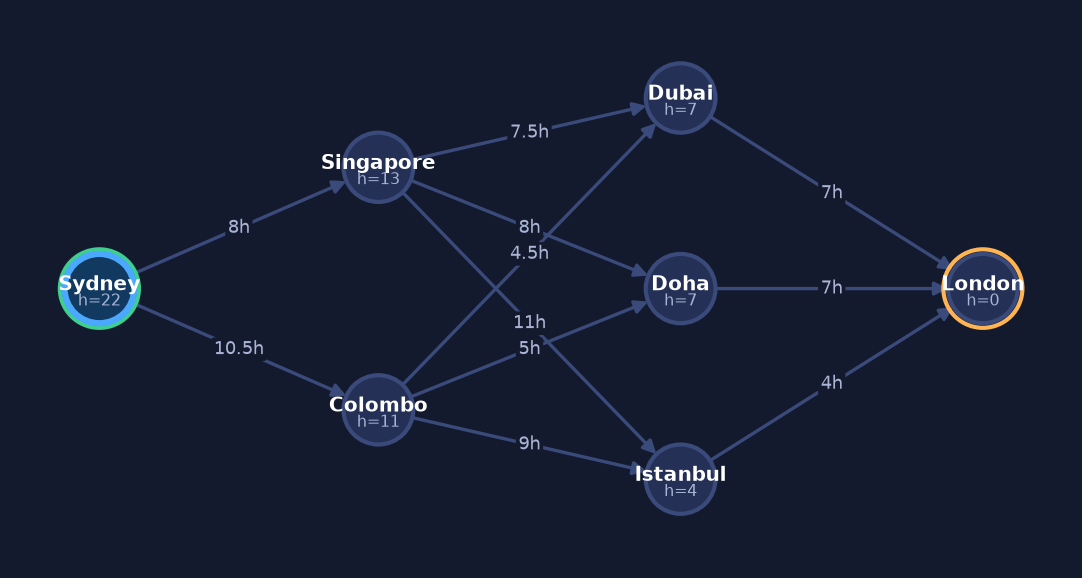
Watch Weighted A* search a real problem — flying from Sydney (SYD) to London (LHR). Click Next to advance one expansion and watch OPEN, the traversal, the path and the cost update live.
OPEN, CLOSED & the data structures
OPEN is a priority queue: it always hands back the node with the smallest f = g + w*h, so the most goal-promising node gets explored next. CLOSED is a set of nodes we've already expanded, used to avoid re-processing the same node and getting stuck in loops. Each node also remembers its best-known g cost and its parent so we can trace the final path back from the goal.
Pseudocode
function WeightedAStar(start, goal, w):   # w > 1
    OPEN = priority queue ordered by f
    g[start] = 0
    f[start] = 0 + w * h(start)
    add start to OPEN
    CLOSED = empty set

    while OPEN not empty:
        n = node in OPEN with smallest f
        remove n from OPEN
        if n == goal:
            return reconstruct_path(n)
        add n to CLOSED

        for each neighbor m of n:
            if m in CLOSED: continue
            tentative_g = g[n] + cost(n, m)
            if m not seen or tentative_g < g[m]:
                parent[m] = n
                g[m] = tentative_g
                f[m] = g[m] + w * h(m)   # weight only on h
                add/update m in OPEN
    return failure   # OPEN empty, no path
At a glance
👍 When to use it
- You need an answer fast and a slightly-longer path is acceptable (robots, games, big maps).
- Plain A* is too slow or runs out of memory because it expands too many nodes.
- You want a tunable knob to trade solution quality for speed by adjusting w.
- You have a bounded guarantee requirement: 'within w times optimal' is good enough.
⚠️ Watch out for
- The weight goes ONLY on h, not on g. f = g + w*h. Weighting g too breaks the meaning.
- Bigger w = faster but worse paths; w must stay above 1 (w = 1 is just plain A*, w -> infinity approaches Greedy Best-First).
- The result is not the shortest path — never claim optimality; only claim 'at most w times optimal'.
- If h is not admissible (it overestimates), the w-times-optimal guarantee no longer holds.
Now see it for yourself
Open Weighted A* in the visualizer — step through it, pause, and watch OPEN & CLOSED change.